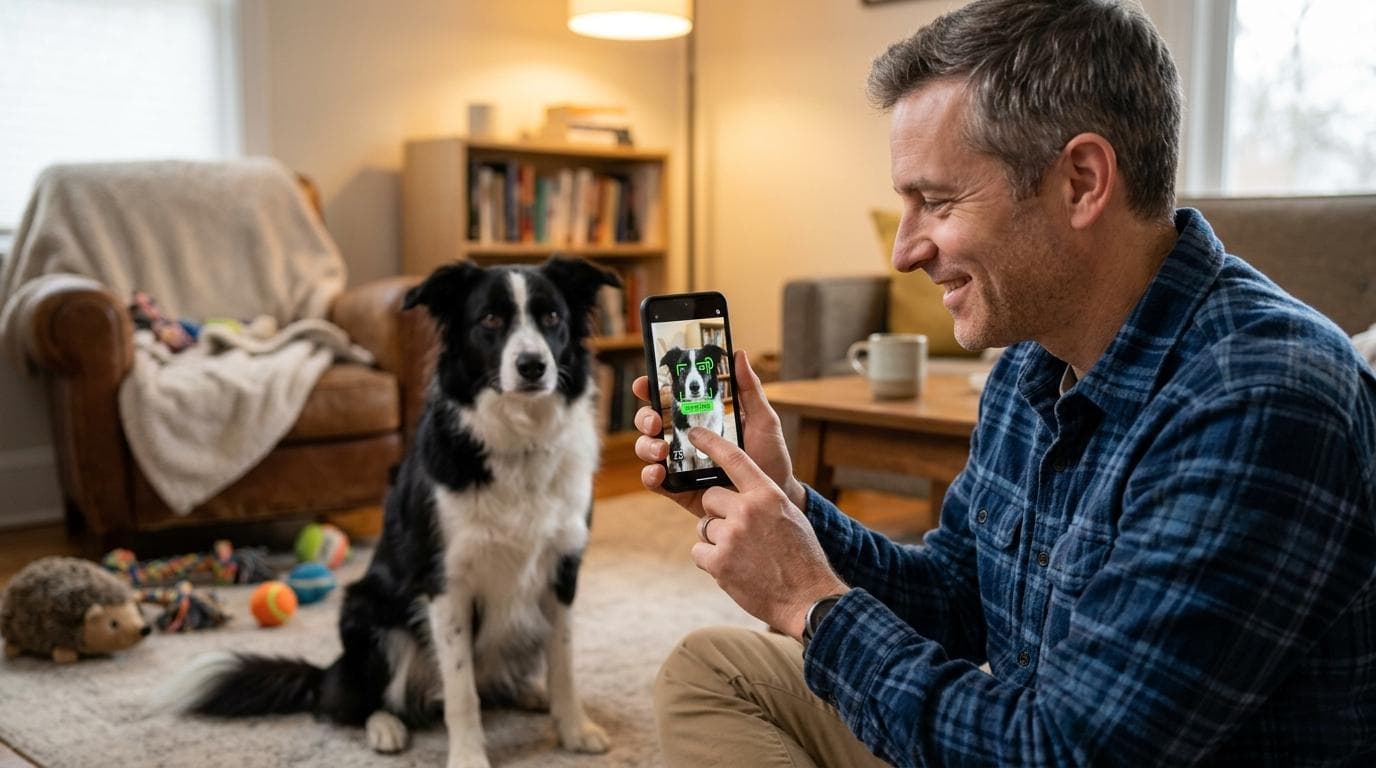
In recent years, as AI technology has become more widespread, the FaunaScan backend receives countless similar questions every day: "Can AI really tell whether my furry friend is happy or sad?" "Is it reliable to use AI to recognize my pet's health status?" As someone who has studied animal behavior for ten years, raised pets for twenty years, and participated in optimizing the FaunaScan AI recognition model, I completely understand everyone's concerns—we all wish for a "helper" to interpret our furry companions' "silent language," yet we worry that AI might not be accurate enough, potentially misjudging our pet's condition and delaying the best time for care.

It wasn't until last year, when I participated in optimizing the FaunaScan AI recognition model and personally input over 1,000 behavioral data points for dogs and cats—including all of my Border Collie Ollie's little quirks—that I truly understood. Ollie bounces in place when he's happy, with ears perked up and tail wagging rapidly; when anxious, he frequently licks his paws, avoids eye contact, and even refuses food; when slightly unwell, he becomes lethargic and his gait slows. I watched the AI system learn from this data little by little. From initially only recognizing simple emotions like "happy" or "angry," it eventually became capable of accurately identifying signals of "mild anxiety" and "potential pain." In that moment, I truly realized that AI animal behavior analysis technology has entered an entirely new phase.
At three in the morning yesterday, I was woken by a soft whimpering—it was my mischievous Border Collie Ollie, lying by my bedside with ears drooped, tail tucked between his legs, and his whole body trembling slightly. I reached out to feel his forehead—no fever—but he refused to get up, his eyes filled with unease. He wouldn't even look at his favorite treats. In that moment, my heart clenched. I'm sure many pet owners have experienced that helpless feeling, right? You know something's wrong, that your pet is uncomfortable or unhappy, but you can't figure out what's bothering them—whether it's emotional anxiety or a physical issue.

Honestly, when I first encountered AI animal emotion and health recognition technology, I was skeptical. After all, animal emotions are incredibly complex—just like with us humans, "unhappiness" might lead one dog to tear apart the house while another silently curls up in a corner. Similarly, with "physical discomfort," some cats lose their appetite while others become unusually clingy. These subtle differences are things even we professional animal behaviorists need to assess through long-term observation. Could AI really handle that?
Many pet owners might wonder: how exactly does AI recognize animal emotions and health status? Actually, it's not complicated at all—in simple terms, it's a combination of "big data" and "professional knowledge." The AI system collects large amounts of data on animals' facial expressions, body movements, vocal frequencies, and even physiological indicators, then combines this with the professional expertise summarized by animal behaviorists to build recognition models. For example, when a cat frequently licks its fur and its coat becomes disheveled, the AI uses data to determine it might be experiencing "anxiety." When a dog shows abnormal gait and lethargy, the AI can flag "possible health concerns" and suggest seeking veterinary care.

But I must be honest with everyone—AI is not yet "omnipotent," and it still has many limitations. Take Ollie, for instance. Once, he became lethargic after eating too much and having digestive issues. The AI identified "possible pain or internal discomfort," which was quite accurate. But another time, when I was away on a two-day business trip, he became anxious but deliberately acted calm—just being less active. The AI only identified "low mood" that time, without recognizing it as "separation anxiety." This is where AI falls short—it can capture obvious behavioral signals but struggles to accurately interpret those "hidden" emotions and subtle individual differences.
At this point, many people might be curious: where is next-generation AI animal behavior analysis headed? Drawing from my experience participating in optimization, I believe the core directions are "personalization" and "precision." In the future, AI will build customized recognition models based on each animal's breed, age, and individual habits. For example, with "tail wagging," AI will know that for Ollie, wagging means happiness, while for some dogs, it might indicate nervousness. Similarly, with "loss of appetite," AI will consider the cat's age to determine whether it's just indigestion or a sign of age-related illness.

Moreover, future AI will integrate with smart devices—using collars to monitor our furry companions' heart rate, body temperature, and activity levels in real time, combining this with behavioral signals for comprehensive assessment of their emotional and health status. Just like the smartwatches we humans use that alert us to physical abnormalities, our pets will have their own "smart guardians." I can even imagine a future where opening FaunaScan reveals personalized AI recommendations: "Ollie seems a bit anxious today—suggest spending an extra 10 minutes playing fetch" or "Your cat's appetite has recently decreased, possibly due to digestive discomfort—consider adjusting their diet." That's where AI can truly help us.
I remember when I first adopted Ollie—as a stray dog, he had severe separation anxiety. It took me eighteen months to slowly help him rebuild trust. Back then, such advanced AI technology didn't exist. I had to wake up before dawn every day to observe his behavior and record his emotional changes. If FaunaScan's AI tools had been available then, I believe I could have understood his unease more quickly and helped him overcome it sooner.
I always say—and many of you have probably heard me say this—"Even if today the animal just looks at you a moment longer without running away, that's still a victory." The same goes for AI animal behavior analysis technology. Even if today it only accurately identifies one instance of our furry companion's emotional irregularity, even if it only gives us one useful suggestion—that's still progress. It won't replace the love and companionship we give our pets, but it can become a "good helper" that helps us understand them better, avoid pitfalls, and find greater peace of mind.
Have you ever used AI tools to recognize your furry companion's emotions or health status? What issues have you encountered while using them? Do you find AI highly accurate, or do you feel it still has many shortcomings? I hope we can learn from each other and grow together, wholeheartedly accompanying our pets as they grow. After all, loving them begins with understanding their silence—and AI is simply a "little helper" that helps us read them better, isn't it?